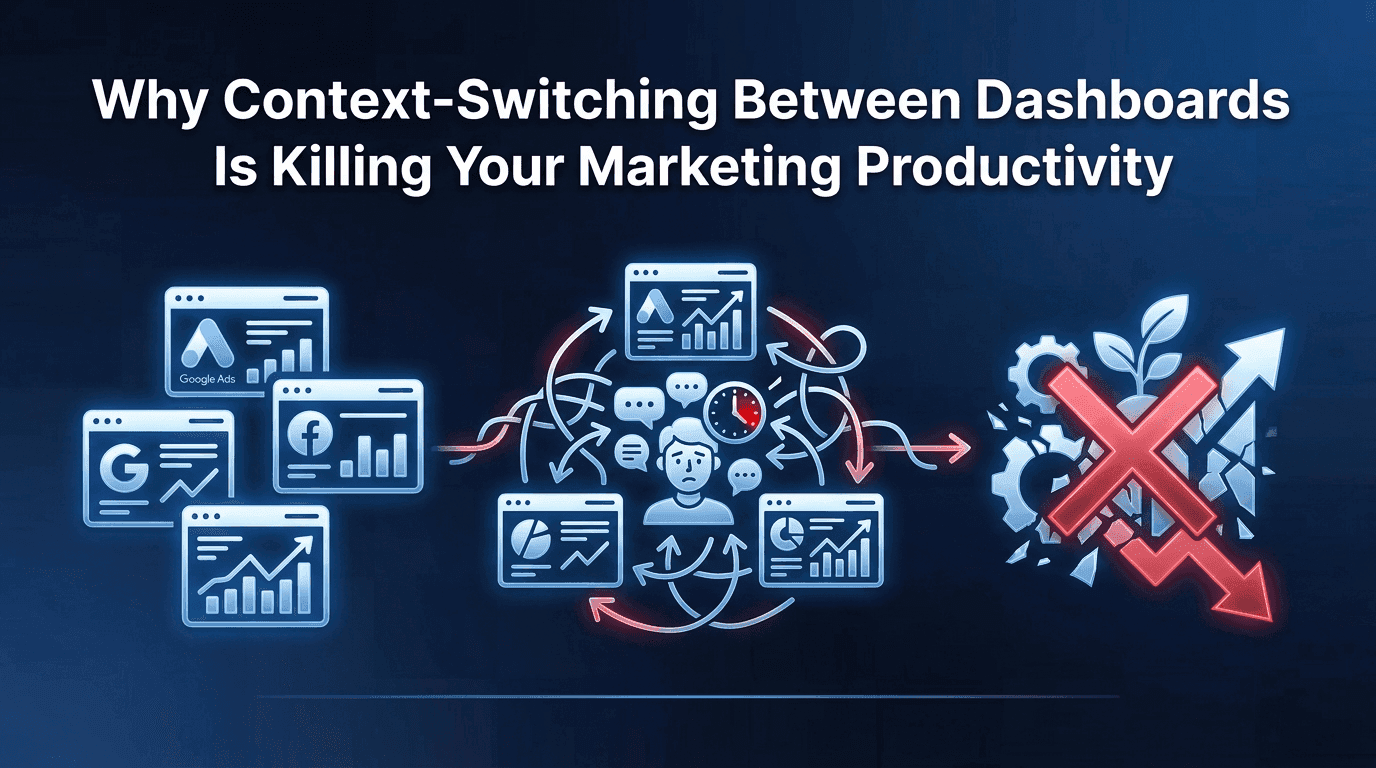
The average mobile marketer switches between 4-6 dashboards before making a single optimisation decision. Each switch resets your focus, breaks your flow, and costs you time you don't get back.
You open Meta Ads Manager to check campaign performance. The numbers look concerning, so you flip to Google Ads to compare. Then to your MMP to see if the attribution aligns. Then to a spreadsheet to merge the numbers and finally to Slack to update the team. By the time you've finished the context-switching dance, 45 minutes have passed and you haven't made a single decision.
This isn't a data problem. This is a productivity problem.
The Cognitive Cost of Dashboard Fragmentation
Context-switching destroys more than time. Research on attention and task-switching shows that each switch imposes a cognitive penalty: your brain needs 5-15 minutes to fully re-engage with the new context. When you're jumping between four dashboards, you're burning 20-60 minutes per day just on context resets.
But the real cost is decision quality. When you're halfway between two systems, reconciling different numbers, and trying to remember what you saw on the previous screen, your brain is in reactive mode, not strategic mode. You're problem-solving discrepancies instead of optimising performance.
The illusion of productivity is the worst part. You feel busy all day. Your calendar shows "attribution review" blocked. But the actual time spent on decision-making? That's often less than 20% of the total review block.
How Many Dashboards Are You Actually Using? (An Honest Audit)
Write down every tool you open during a typical optimisation session. Most teams land on the same list:
Meta Ads Manager (campaign performance)
Google Ads or Google Analytics (Google campaign data)
Your MMP (attributed installs and ROAS)
GA4 or another analytics platform (event funnels)
A spreadsheet or Sheets doc (your "source of truth" merge)
Slack (stakeholder updates)
That's six logins, six separate dashboards, and six different data models, all before you've made a single action.
Then multiply that by your team size. If you have three people running UA and each does this daily, that's 18 hours per week of pure context-switching overhead. At a Rs50 lakh annual salary, that's Rs3.5 lakh in annual productivity loss, and that's just the direct time cost.
Why "Best of Breed" Becomes "Worst of Focus"
The "best of breed" philosophy made sense 10 years ago when each tool was dramatically better at one thing. Pick the best attribution tool, the best ad platform, the best analytics tool, and cobble them together.
But here's what happens: Meta says you got 500 installs yesterday. Your MMP says 380. Google Analytics says 420. Three different numbers from three authoritative sources. Which is right? All of them, technically. They're measuring different things. Meta counts app opens, your MMP counts attributed installs, GA4 counts web-app events. You end up merging your MMP analytics with your marketing intelligence workflows just to make sense of it all.
Reconciling these discrepancies takes time. A lot of time. And every discrepancy erodes trust in your data. This is exactly why your Meta ROAS doesn't match your MMP data and why you're stuck trying to fix the disagreement. You stop believing any single source and start treating your spreadsheet merge as the "real" dashboard, which defeats the entire purpose of having modern tools.
This is the reconciliation tax: the hours spent figuring out which number to trust instead of the hours spent acting on the data.
What a Unified Dashboard Actually Changes
A unified dashboard doesn't eliminate the data sources. Meta still sends clicks. Google still sends installs. You still have multiple channels with different measurement models. But a unified dashboard creates a single source of truth that has already reconciled these differences for you.
One login. One interface. One source of truth. One set of filters that apply across all your data.
Speed-to-decision changes dramatically. Instead of 45 minutes, you're looking at 10 minutes. Open the dashboard. See which channels and campaigns are performing against target. Decide which ones to scale and which to pause. Done.
But more importantly, consistency changes. Every time a stakeholder asks about attribution performance, they get the same answer from the same source. No more "my spreadsheet shows 18% ROAS but my ads manager shows 22%."
The cognitive burden of switching context is gone. Your brain can stay in strategy mode instead of constantly context-shifting between interfaces.
The Three Dashboards That Should Survive a Stack Audit
You don't need zero dashboards. You need three.
Dashboard 1: Your MMP (attribution + deep linking + ROAS). This is your decision hub. It shows you which channels, campaigns, and cohorts are profitable. It has your event funnels, your SKAN data, your revenue attribution. This is the one you open first and check most frequently.
Dashboard 2: Your ad platforms (Meta + Google). But here's the key: you use these only for campaign management and creative testing, not for attribution or performance analysis. Use them to launch new campaigns, check audience sizes, and monitor daily spend against budget. But for "is this campaign profitable," you defer to your MMP.
Dashboard 3: A BI tool (Looker, Tableau, Metabase). Only if you need it. Most teams under Rs1 crore in monthly ad spend don't. Your MMP dashboard already shows you everything you need: channel ROAS, campaign CPI, cohort retention, revenue attribution. A BI layer adds complexity that doesn't pay for itself unless you're doing deep funnel analysis or cross-function reporting that your MMP can't handle.
Everything else is a candidate for consolidation or elimination. Spreadsheet as "source of truth"? That can go. GA4 for performance analysis? That can go. Custom in-house dashboards? That can go.
Here's why this matters: fewer dashboards means fewer reconciliation points, fewer mental models to keep straight, and faster decisions.
How to Run a Dashboard Consolidation Sprint
This isn't a one-day project. It's a structured three-week sprint with clear checkpoints.
Week 1: Audit.
List every tool your team uses for attribution, performance analysis, and reporting. For each one, write down: (1) Who uses it? (2) What decisions does it drive? (3) What data does it show that nothing else shows?
The goal is to map every tool to a decision. If a tool doesn't drive a decision, it's a candidate for elimination. If it drives a decision that another tool can drive, it's a candidate for consolidation.
Week 2: Identify overlap and build the new stack.
Look at your audit. Identify which decisions can consolidate into one dashboard. For most teams, that's "use your MMP for attribution decisions" and "use your ad platforms for campaign management." Everything else flows into those two.
Build out your new three-dashboard stack. Get your MMP configured with the right saved views. Create the ad platform views you'll actually use. Decide if you need a BI layer, and if so, which one.
Week 3: Migrate and redirect.
Point your team to the new dashboards. Update all saved links and bookmarks. Set a date when the old tools are no longer checked. This matters: you can't consolidate if people keep opening the old dashboards out of habit.
Run one joint training session where everyone opens the new stack and walks through a sample optimisation decision together. The muscle memory of "here's the workflow" matters more than detailed feature knowledge.
Key Takeaway
You're not slow because you don't have good data. You're slow because you're paying a massive cognitive cost every time you switch contexts. Consolidate your stack to three dashboards, and you'll recover 10-15 hours per week of productivity. Redirect those hours into creative testing, channel expansion, and strategic planning instead of context-switching and reconciliation.
If you want to try a unified MMP that brings attribution, deep linking, and campaign intelligence into one screen, request a demo from Linkrunner. It's designed specifically to eliminate the multi-dashboard reconciliation problem.
FAQ
Q: How many dashboards should a mobile marketer realistically use daily?
Three: your MMP for attribution decisions, your ad platforms for campaign management, and optionally a BI tool if you're doing deep funnel analysis. Everything beyond that is context-switching tax.
Q: Does using fewer dashboards mean I lose granularity in my data?
No. A well-configured MMP gives you far more granularity than most teams actually use. The constraint isn't data. It's your ability to act on it. Fewer dashboards, more action.
Q: How do I convince my team to stop using ad platform dashboards for attribution?
Show them one side-by-side session: Meta says 500 installs, your MMP says 380. Then ask: "Which number are we optimising for?" When they realise ad platforms are measuring something different, the consolidation becomes obvious.
Q: What's the fastest way to audit which dashboards my team actually needs?
Ask each person to log their Slack messages and emails from the last week. What numbers did they request or share? Those are the decisions your dashboards need to support. Everything else is candidate for elimination.